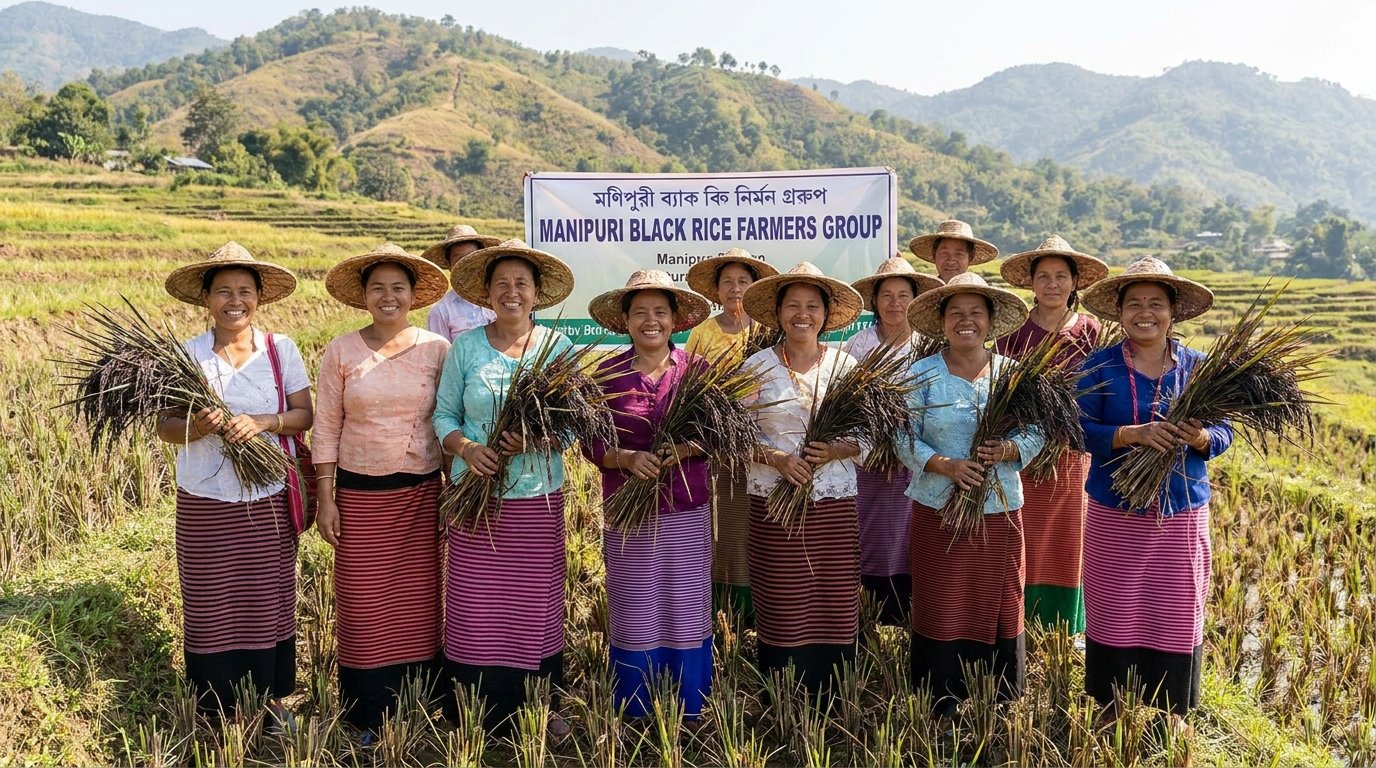
Type "black rice supplier" into a search bar and you'll turn up everything from a single-estate cooperative in Imphal East to a trader blending stock from three countries into one unmarked bag. For a Singapore-based buyer, that difference matters — for your food-safety compliance, for any GI-origin claim you print on packaging, and for whether the same supply is still there next planting season. This guide sets out where black rice suppliers in Northeast India are genuinely based, how the supply chain is structured, and what to check before an order is confirmed.
Why Source Black Rice From Northeast India
Northeast India is not a single brand or a single farm — it is a seven-state growing region that happens to sit on one of the most genetically diverse rice belts on earth. Researchers have catalogued well over 10,000 rice landraces across the region, a good number of them black-pigmented, grown by smallholder communities who have kept these varieties largely unchanged for generations. Manipur's Chak-Hao Amubi is the name most Singapore buyers will already recognise, thanks to its GI tag and its association with Chak-Hao Kheer. But it is not the only source worth knowing about.
Assam, in particular, grows black rice landraces at a scale that is genuinely comparable to Manipur, even though it rarely gets the same attention internationally. Understanding this wider picture matters for sourcing, because it means a Singapore buyer has more than one legitimate origin to choose from — but it also means "Northeast Indian black rice" is not one standardised commodity. Quality, GI status and even the specific landrace can differ significantly from state to state, and sometimes from one cooperative to the next within the same district.
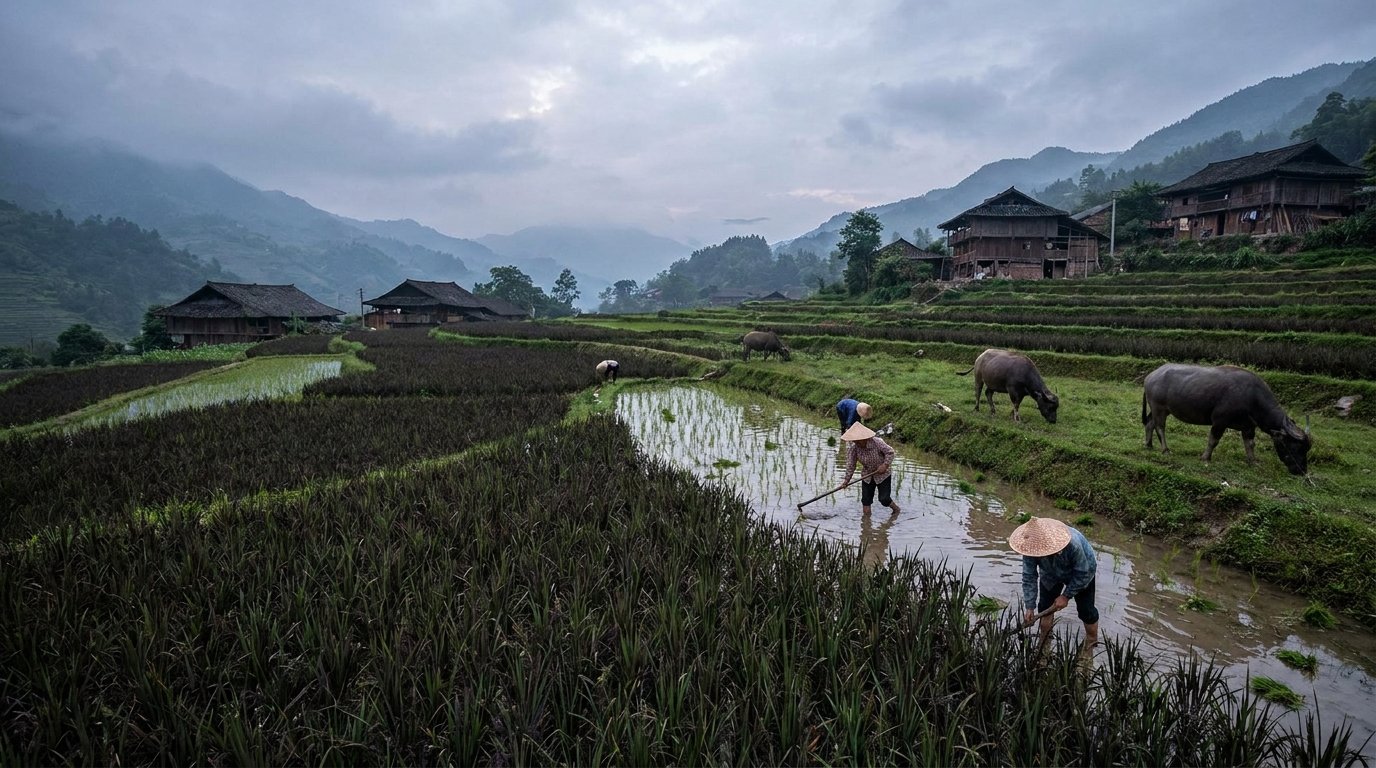
Which States Actually Supply Black Rice
"Northeast India" covers Arunachal Pradesh, Assam, Manipur, Meghalaya, Mizoram, Nagaland and Tripura. Not all seven contribute meaningfully to commercial black rice supply, so it's worth knowing where the genuine volume sits before you start shortlisting suppliers.
Manipur
Home to Chak-Hao Amubi, concentrated in the Imphal valley districts of Imphal East, Imphal West, Bishnupur and Thoubal. The state most Singapore buyers mean when they say "Manipur black rice," and the source with the most established export infrastructure.
Nagaland
Officially included in the same Chak-Hao GI registration as Manipur, with cultivation centred on Peren district. Volumes are smaller and supply is often organised through Manipur-linked consortia rather than as a standalone export channel.
Assam
Alongside Manipur, Assam is one of the region's two largest black rice producers, with landraces concentrated in upper Assam districts. Not covered by the Chak-Hao GI, so genuinely indigenous stock here still can't legally carry the Chak-Hao name.
Meghalaya
Smaller-scale cultivation, particularly around the Garo Hills, usually alongside the state's better-known Joha aromatic rice. Worth asking about if you're looking to diversify beyond Manipur and Assam.
Mizoram
Part of the region's broader black rice landrace pool, though on a smaller commercial footing than Assam or Manipur. Sourcing here usually runs through smaller, less formalised cooperatives.
Tripura
Increasing cultivation of indigenous black rice landraces has been documented here as part of a wider regional push to diversify beyond staple white rice, though commercial-scale export supply is still limited.
Arunachal Pradesh
Contributes to the region's broader rice biodiversity and is included in most national genetic surveys of Northeast Indian rice, but black rice specifically is far less commercially established here than in the other six states.
The GI Tag: What It Actually Means for Buyers
Chak-Hao received its Geographical Indication registration on 20 April 2020, following an application by the Consortium of Producers of Chak-Hao, Manipur, which took over the filing originally lodged by NERAMAC in 2017. One detail that surprises a lot of buyers: the registration's legal geographical area is not Manipur alone — it explicitly covers Manipur and Nagaland's Peren district. The registration currently runs through late 2027, with renewal expected in the usual course.
What a GI tag actually protects is narrower than people assume. It doesn't certify that every bag is high quality — it legally ties the name "Chak-Hao" to rice grown within that defined territory, in roughly the same way "Darjeeling tea" is protected for tea grown in Darjeeling. Rice grown in Assam, Meghalaya or anywhere else in the region, even if it's a genuinely indigenous black landrace, cannot legally be sold under the Chak-Hao name. For a Singapore buyer, that's a useful, low-effort way to sanity-check a supplier's claims: ask them directly whether their stock falls inside the GI area, and if they're using the Chak-Hao name, ask for their GI usage authorisation.
Types of Suppliers You'll Come Across
Most black rice suppliers in Northeast India fall into one of four broad categories, and each suits a different kind of buyer.
| Supplier Type | Traceability | GI Documentation | Best Suited For |
|---|---|---|---|
| Farmer Producer Organisation / Cooperative | High — direct from member farms, seasonal lots | Often yes, where members are GI-registered growers | Smaller buyers wanting closer-to-farm sourcing |
| GI-Licensed Exporter / Consortium-Affiliated Processor | High, with formal GI usage documentation | Yes, structured around GI compliance | Buyers needing GI-labelled product for retail |
| Private Trader / Aggregator | Variable — may blend lots or states | Not guaranteed; verify independently | Buyers prioritising flexible volume over single-origin claims |
| Vertically Integrated Grower-Exporter | Highest — paddy to pack under one operation | Yes, managed in-house | Buyers wanting a long-term, private-label partner |
Quality & Purity Checklist Before You Buy
Whichever supplier type you choose, the same checks apply once samples arrive. None of these need laboratory equipment for a first pass.
Grain uniformity & broken-grain ratio
Ask for a sample report on broken grain percentage. Export-grade lots are usually held under an agreed threshold — a supplier who can't quote one is worth questioning.
Moisture content
A safe storage and shipping range typically sits around 12–14%. Higher moisture raises the risk of mould developing over a long sea journey.
Foreign matter & admixture
Check for stray husk, stones or non-black grains mixed through the sample. A reputable mill will state its admixture tolerance without being asked twice.
Colour & bran consistency
Genuine stock looks deep, even purple-black with a matte bran layer. Patchy grey-brown colouring, or a glossy over-polished finish, usually signals a blended or over-processed lot.
Aroma before cooking
Authentic landrace black rice carries a distinct natural aroma even raw. A sample with little to no scent often points to old stock or a diluted blend.
Milling & harvest date
Ask for the milling date, not just the packing date. Pigment intensity and aroma fade gradually the longer rice sits after milling.
Certifications & Documents to Ask For
These are the documents that separate a properly set-up exporter from someone reselling rice they've sourced informally. None of them are unusual to ask about — a genuine supplier should have them ready.
Import Export Code (IEC)
Issued by India's DGFT. Without one, a business legally cannot export anything, regardless of what else it holds.
APEDA Registration (RCMC)
All rice exports from India, Basmati and non-Basmati alike, require the exporter to be registered with APEDA. Shipments from unregistered exporters cannot legally clear Indian ports.
FSSAI Licence
India's domestic food-safety licence for the food business operator. It underpins any claim about how the rice was processed and packed.
Phytosanitary Certificate
Issued by India's Plant Quarantine authority to confirm the consignment is free of regulated pests before it leaves the country.
Certificate of Origin
Issued via the Export Inspection Council, and useful supporting evidence at Singapore customs alongside any GI-origin claim.
GI Usage Authorisation
Only relevant if the product is marketed as Chak-Hao or GI-tagged. Ask to see it directly rather than taking a packaging claim at face value.
Organic Certification
Look for a recognised standard such as India Organic (NPOP) rather than assuming organic status from smallholder farming methods alone.
Halal Certification
Worth asking about if you're supplying halal-conscious retail or F&B channels in Singapore — check that the certifying body is one your own compliance process recognises.
How the Sourcing Process Typically Works
Define your specification
Settle on grain type, whether you specifically need GI-tagged Chak-Hao or are open to a non-GI landrace, organic requirements, packaging format and your target delivery window before reaching out to anyone.
Shortlist and vet suppliers
Cross-check GI usage authorisation where relevant, alongside APEDA registration and FSSAI licensing, rather than relying on a supplier's own marketing claims.
Request and test samples
Run the quality checklist above on whatever arrives. For a large first order, it's worth paying for an independent lab test of moisture and anthocyanin content rather than relying on appearance alone.
Agree terms and Incoterms
FOB from Kolkata or Chennai is common for Northeast Indian-origin cargo. Confirm early who arranges export-side documentation, and who is responsible for the Singapore import permit.
Confirm the harvest and production timeline
Northeast India's paddy is a monsoon-season crop, harvested roughly October to December. Suppliers milling from fresh post-harvest stock generally offer the best pigment and aroma.
Place a trial order before scaling up
A smaller first shipment lets you validate quality and documentation properly before committing to a recurring, larger-volume contract.
Shipping & Import Requirements for Singapore Buyers
Rice is treated differently to most food imports in Singapore, which catches some first-time buyers off guard. It's a controlled item under the Price Control Act and the Price Control (Rice) Order 1990, which means a licence from the Singapore Food Agency is required to import it, re-export it, or deal in it wholesale — separate from the general food-import registration that covers most other products. A customs permit also has to be filed through TradeNet before the cargo arrives, not after.
On the India side, Northeast Indian-origin cargo usually consolidates through Kolkata or Chennai, the nearest deep-water ports to Assam and Manipur, before the sea leg down to Singapore. Ask your supplier upfront who is responsible for the phytosanitary and fumigation paperwork on their end, since this is usually split between the exporter and your own customs broker in Singapore. Import requirements are reviewed periodically, so treat this section as general orientation rather than a substitute for checking the current position directly with SFA or Singapore Customs before your first shipment.
Common Red Flags When Sourcing Bulk Black Rice
- No GI licence number. A "Chak-Hao" or "GI black rice" label with no licence number, and no named cooperative or consortium behind it, is worth querying directly rather than taking at face value.
- Reluctance to share a milling date. A supplier who won't disclose when a lot was milled, or won't send a sample before a large order, is asking you to buy on trust alone.
- Unnaturally uniform, glossy colouring. Because black rice commands a premium over white rice, lower-grade rice coated in synthetic dye to imitate it has been a known issue in some markets. A soak test — colour should release gradually, not bleed out instantly — is a quick first check.
- No traceability to a specific district. A genuine supplier can usually name the district, and often the cooperative, their stock comes from. Vague answers here are worth following up on.
Building a Long-Term Supply Relationship
A single successful trial shipment doesn't automatically make a supplier reliable for the long run — Northeast India's smallholder-linked supply chains still operate on modest yields, typically 3 to 4 tonnes per hectare for indigenous landraces, so consistency depends on planning ahead of the harvest rather than placing ad hoc orders after the fact.
- Plan around the harvest calendar. Paddy is sown with the monsoon and harvested from October through December. Suppliers appreciate early volume forecasts, since it helps them plan planting and milling capacity with their member farmers.
- Ask about private-label options. Vertically integrated exporters in particular often offer custom packaging and labelling for buyers who want to build their own retail brand around the rice.
- Put quality specs in writing. A supply agreement should cover grain specifications and GI documentation, not just delivery schedule and quantity — that's what protects you if a future lot doesn't match the sample you approved.
Sourcing black rice from Northeast India for the Singapore market? Get documentation, packaging options and a sample sent to your trade desk.
Frequently Asked Questions
The Bottom Line
"Black rice suppliers in Northeast India" covers a lot more ground than one Manipuri cooperative, and treating the whole region as interchangeable is where most sourcing mistakes start. Assam and Manipur carry the bulk of genuine commercial supply, the Chak-Hao GI tag protects a specific name rather than the whole category, and the paperwork — IEC, APEDA, FSSAI, phytosanitary certification — is what actually separates a properly set-up exporter from a reseller. For a Singapore buyer, pairing that groundwork with your own SFA licensing on the import side is what turns a one-off sample order into a supply chain you can actually build a business around.
Further Reading
- Geographical Indications Registry, India — Chak-Hao GI application details
- NERAMAC — Chak-Hao Black Rice GI product listing
- Singapore Customs / Singapore Food Agency — regulation of import, export and wholesale dealing of rice