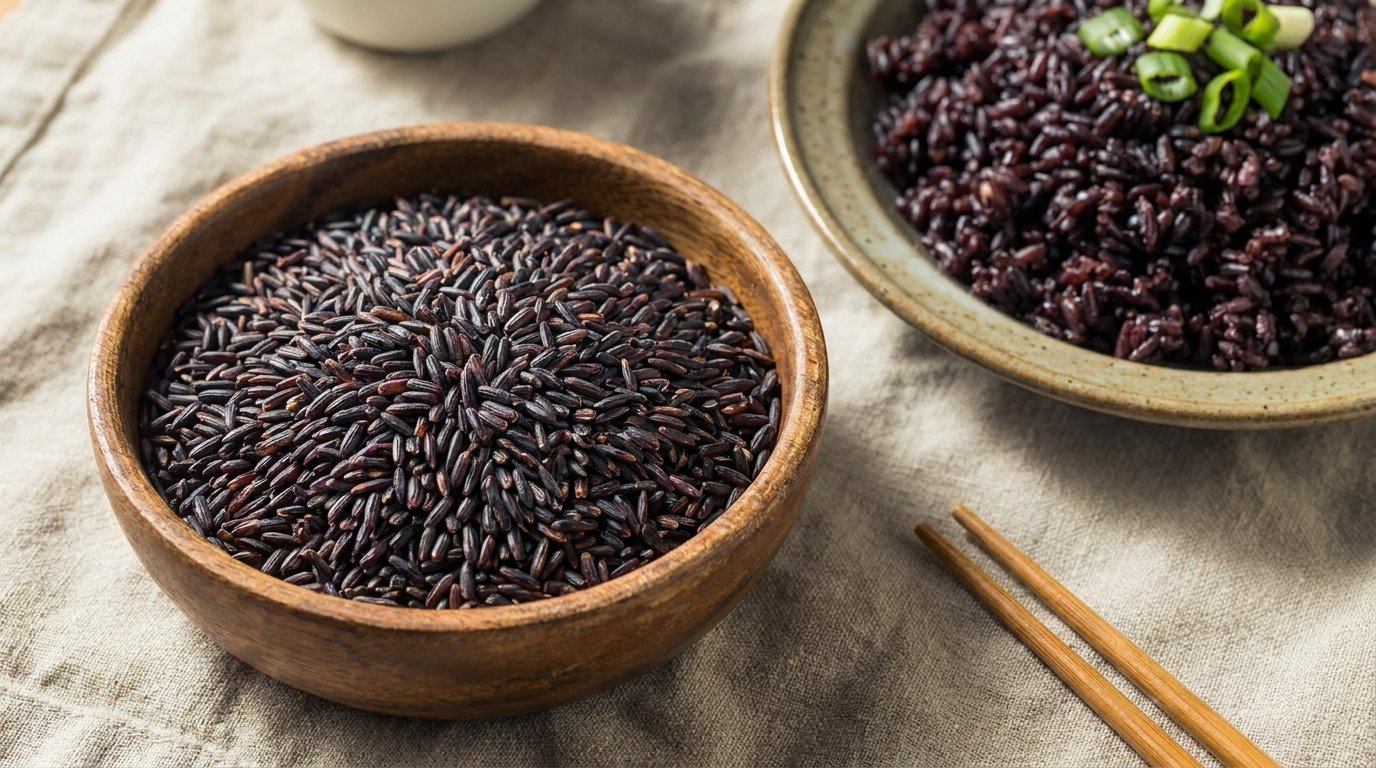
Buying black rice in bulk is a different exercise than picking a bag off a shelf — the question stops being "does it taste good" and becomes "will the tenth sack look, smell and cook exactly like the first." Whether you're a retailer restocking a shelf, a manufacturer building it into a product, or a distributor placing a container order, the fundamentals of buying black rice in bulk are largely the same: consistent grain quality, clear certification, sensible packaging, and a supplier who can answer logistics questions without a week of back-and-forth. This guide covers all of it, using our own GI-tagged Manipur black rice (Chak-Hao) program as the working example.
What Counts as Buying Black Rice in Bulk?
There's no official cutoff where a "regular" order becomes a bulk order — it's more of a spectrum than a fixed number. In practice, most suppliers start treating an order as bulk once it moves past a standard retail bag, somewhere around the 25 kg mark, and the category stretches all the way up to multi-tonne container shipments for export. What actually changes at each step isn't just the size of the invoice — it's the packaging format, the paperwork involved, and how much lead time a supplier needs to fulfil it.
It's worth thinking of black rice in bulk as three loosely defined bands rather than one thing: a wholesale band for retailers and foodservice operators restocking regularly, a distribution band for regional buyers moving pallet-scale volumes, and an export band for international importers ordering by the container. A supplier worth working with should be able to move between all three without the underlying quality — grain size, aroma, moisture content — changing from one order to the next.
Who Actually Buys Black Rice in Bulk
Demand for bulk black rice comes from a fairly narrow set of buyer types, and each one is optimizing for something slightly different when they place an order.
Shelf-Ready Stock
Care most about consistent case-pack sizes, shelf-stable packaging, and a product that looks identical from one restock to the next.
Ingredient-Grade Supply
Use black rice as a component in blends, flours or snack formats, so grain size and moisture content need to stay within a tight range batch to batch.
Menu-Volume Orders
Order at a scale that supports a recurring menu item — black rice pudding or grain bowls, for instance — and care about cook time staying predictable.
Container-Scale Orders
Buy at the largest end of the scale to redistribute across a region or country, and generally prioritize documentation and shipping terms above everything else.
Bulk Packaging Formats, Compared
Packaging is usually the first real decision in a bulk order, since it shapes everything downstream — freight cost per kilo, shelf presentation, and how much handling happens before the rice reaches an end customer.
Retail-Ready Pouches
Typically 1–5 kg, pre-branded and sealed, meant to go straight onto a shelf without any repackaging on the buyer's end.
Wholesale Sacks
Standard 25–50 kg woven or kraft sacks — the most common format for foodservice operators and manufacturers who repackage or portion on-site.
Jumbo Bags & Private Label
FIBC "jumbo" bags for container-scale export orders, or fully custom private-label packaging for retailers building their own brand around the rice — the two formats most bulk buyers eventually ask about.
Order Volume Tiers: Sample to Container Load
Rather than quoting a single minimum, it helps to think in tiers — each one suited to a different stage of building out a bulk supply relationship.
Enough to test aroma, cooking time and grain consistency before committing to anything larger — worth requesting from any new supplier.
The typical range for retailers, foodservice groups and regional distributors restocking on a recurring schedule.
Full or partial container loads for international distributors and importers, generally shipped under standard export documentation.
Bar widths are illustrative, not exact proportions — confirm current tier availability and case-pack options with our trade desk.

How to Vet a Bulk Black Rice Supplier
- 1Ask for a sample batch first. Never commit to a full-volume order sight unseen — a small sample tells you almost everything about aroma, texture and cooking behavior.
- 2Confirm the origin claim directly. Ask specifically where in Manipur the rice was grown and whether that claim is independently verifiable through GI documentation.
- 3Request certification paperwork. Organic certification, lab test reports for pesticide residue and heavy metals, and — for imports — a phytosanitary certificate.
- 4Check batch-to-batch consistency. Ask whether grain size, color and moisture content are tested on every harvest lot, not just once when the relationship began.
- 5Clarify lead times and logistics upfront. How long from purchase order to shipment, which Incoterm applies, and who's responsible for customs paperwork on each end.
Certifications Worth Confirming Before You Order
Bulk buyers are effectively vouching for the product to their own customers, so it's worth treating certification as due diligence rather than a marketing detail.
GI Certification
Legally ties the "Chak-Hao" name to rice grown in Manipur. It's the strongest anti-counterfeiting signal available, though it doesn't by itself confirm organic status or lab-tested purity.
Organic Certification
Verifies farming practice rather than origin, issued by an accredited certifying body — worth checking the certificate number rather than taking a logo at face value.
Batch Lab Testing
Testing each harvest lot for pesticide residue, heavy metals and moisture is the check that actually protects a bulk buyer's own customers. Ask for the report itself, not just a summary claim.
Storing Black Rice in Bulk Without Losing Quality
Bulk quantities magnify small storage mistakes. Held in a cool, dry space away from direct light, raw black rice typically holds its color, aroma and nutritional value for eight to twelve months — noticeably less if it's stored somewhere warm, humid, or exposed to sunlight, since light gradually fades the anthocyanin pigment that gives the grain its color.
- Keep it sealed and opaque. Clear packaging on an open shelf accelerates pigment fade far faster than most warehouse teams expect.
- Rotate stock on a first-in, first-out basis. Bulk sacks sitting untouched for months lose aroma even under good conditions.
- Watch humidity, not just temperature. Large sacks trap moisture more easily than small retail bags, which raises the risk of clumping or mold if a warehouse isn't climate-controlled.
- Plan pest control at scale. Bulk grain storage warrants the same pest-management standards used for any other whole-grain commodity, not an afterthought.
Domestic Delivery vs. Export Shipment
How a bulk order moves depends heavily on where it's going, and each tier comes with its own documentation.
Domestic Bulk Delivery
Pallet or less-than-truckload freight within India, with shorter lead times and simpler paperwork — typically just an invoice and standard tax documentation.
Regional Distribution
Multi-state distribution may call for FSSAI registration details on file, and moisture control during transit matters more as distances grow.
International Export
Requires a phytosanitary certificate, certificate of origin, and agreed Incoterms (FOB, CIF, and so on) — worth confirming who arranges each document before the order is finalized.
What Actually Drives Bulk Black Rice Pricing
Because bulk pricing depends on so many moving parts, most suppliers quote per enquiry rather than publishing a flat rate. The factors that actually move the number are fairly consistent across the industry:
- Order volume and packaging format. Larger volumes and simpler packaging (plain sacks vs. custom private label) generally scale more efficiently than small, highly customized runs.
- Certification level. Organic-certified stock typically costs more to produce, verify and audit than conventionally farmed rice.
- Degree of processing. Lightly milled rice that retains more bran is handled differently than more heavily polished stock.
- Seasonal timing. Ordering close to harvest generally looks different from placing the same order off-season.
- Shipping distance and Incoterm. Who pays for freight, insurance and customs clearance changes the landed cost significantly.
- Custom packaging requirements. Private-label runs and non-standard case packs add lead time and setup cost compared with standard sacks.
Rather than publishing a number that won't reflect your specific order, our trade desk quotes based on the exact volume, packaging and destination you need — reach out for a figure that actually applies to your order.
How to Place a Bulk Black Rice Order, Step by Step
- 1Send your requirements. Share the volume, packaging format and delivery destination so a supplier can confirm what's realistic before quoting anything.
- 2Request a sample and spec sheet. Ask for a sample batch plus a specification sheet covering grain size, moisture content and harvest date.
- 3Confirm certifications and documentation. Verify GI origin paperwork, organic certification, and any import-specific documents you'll need.
- 4Agree on Incoterms and lead time. Settle who arranges shipping and customs clearance, and confirm a realistic timeline from PO to delivery.
- 5Confirm the purchase order and track shipment. Finalize quantities and packaging in writing, then track the shipment through to delivery or port clearance.
Ready to move from research to a real order? Get packaging options, MOQs and documentation from our trade desk in minutes.
Frequently Asked Questions About Buying Black Rice in Bulk
The Bottom Line
Buying black rice in bulk comes down to the same handful of questions regardless of whether the order is 100 kg or a full container: is the origin verifiable, is the quality consistent lot to lot, is the packaging right for how it'll actually be used, and does the supplier have the documentation to back all of it up. Get those right, and volume becomes a logistics detail rather than a risk. To understand what makes the underlying grain worth sourcing in the first place, read our full guide to Manipur black rice and its GI tag, or reach out directly through our product page to start a wholesale conversation.