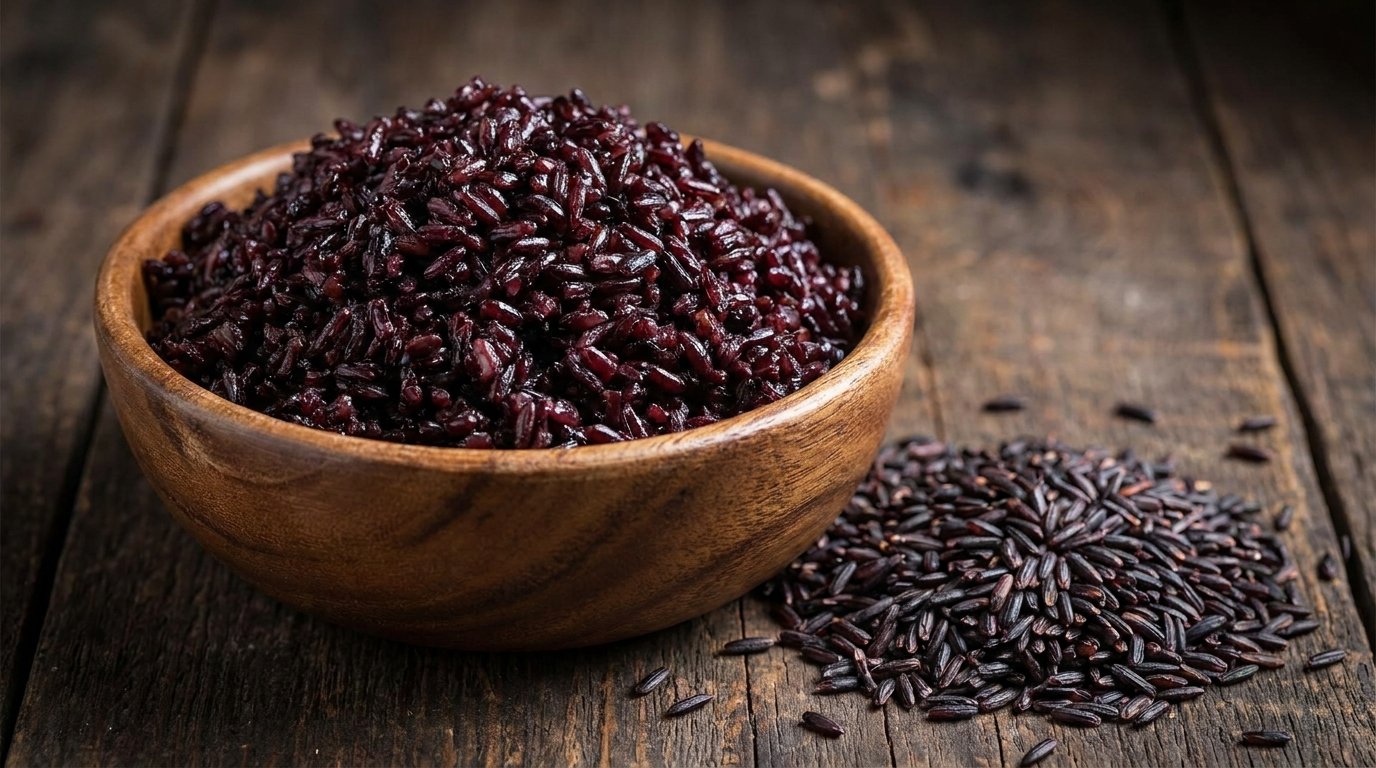
Say "rice production in India" and most people picture Punjab's paddy belt or the Gangetic plains. Black rice production in India looks nothing like that. It's small, regional, and until fairly recently barely tracked at all outside agricultural research papers — grown almost entirely in Manipur, in the wetland valley around Imphal, under the local name Chak-Hao. This article sets the nutrition and recipes side of that story aside and looks purely at the production question: where black rice actually comes from in India, how much of it exists, how it gets from paddy to package, and why Manipur's version of it has become known as the best black rice in Manipur — and, increasingly, on export shelves abroad.
What Counts as "Black Rice Production" in India?
Black rice is a pigmented, anthocyanin-rich variety of Oryza sativa — the same rice species behind every other grain of rice grown in the country, just with a bran layer that stays dark purple-black instead of being bred and milled toward white. Because it's a niche, heirloom crop rather than a mainstream commodity, India's rice statistics don't break it out as its own line item the way they do for staple varieties; it gets folded into general paddy production figures for the states that grow it. That's part of why black rice production in India is so hard to pin down in exact tonnage — the crop simply isn't tracked the way basmati or parboiled rice is.
What is well documented is where it grows, how it's farmed, and how those numbers are changing. That's the more useful lens for understanding this crop, and it's where the rest of this guide is focused.
Where Is Black Rice Grown in India?
Unlike India's major rice belts, black rice cultivation isn't spread across many states in comparable volume — it's concentrated in a few pockets, with one state doing the bulk of it and a handful of others growing it on a much smaller, often experimental scale.
India's Black Rice Growing Regions
A relative view of where black rice cultivation is established versus still emerging across India.
Illustrative comparison of cultivation footprint, not exact tonnage — India doesn't publish separate national production statistics for black rice, since it's recorded within broader state paddy data.
Manipur's share of that map sits mainly in four valley districts — Imphal East, Imphal West, Bishnupur and Thoubal — and the Geographical Indication protection around the Chak-Hao name actually extends one district further, into Peren in neighbouring Nagaland. Assam's black rice story is younger and smaller: it took root around 2011 when a farmer in Goalpara district began growing black rice seed sourced partly from Manipur, and state agricultural bodies have since backed further trials across roughly a thousand hectares. Odisha grows its own black rice landraces, including one known as Kalabati, but typically gets only a single Kharif-season harvest a year, compared with Manipur's Chak-Hao, which its shorter growth cycle allows farmers to raise more than once annually. Smaller, scattered plots turn up in West Bengal, Tamil Nadu, Meghalaya, and even as far off as Maharashtra, where a couple of Akola-based farmers have grown trial batches of black rice in recent years.
Manipur: Home of India's Best Black Rice
Ask why Manipur, specifically, ended up as the source of the best black rice in Manipur — and by extension, in India — and the answer isn't marketing shorthand. It comes down to a specific combination of traits that other black rice-growing regions haven't matched: a pronounced natural aroma that develops on cooking, a stickier and more glutinous grain than most black rice varieties grown elsewhere, and since 2020, a Geographical Indication registration that legally reserves the Chak-Hao name for rice grown within its recognised Manipur and Nagaland growing area.
That GI protection (the application process began in 2019, with formal registration following in 2020) matters for production as much as branding. It means a bag can only be labelled Chak-Hao if the rice inside genuinely traces back to this specific growing region, which is exactly the kind of verification international buyers look for when sourcing a specialty crop rather than a generic commodity. Within Manipur itself, the rice is known more precisely as Chak-Hao Amubi — "amubi" meaning black — one of four colour variants in the wider Chak-Hao family, and the one that carries the deepest pigmentation and the highest anthocyanin content.
How Much Black Rice Does Manipur Actually Produce?
By the standards of mainstream rice farming, black rice yields in Manipur have historically been modest. Traditional Chak-Hao landraces are tall, old varieties that were never bred for volume, and they typically produce under two tonnes of rice per hectare — a fraction of what a modern high-yield white rice variety can return from the same land.
That's beginning to change. In 2024, the ICAR Research Centre in Manipur released RC Manichakhao-1, the state's first semi-dwarf, high-yielding black rice variety, developed specifically to lift production without giving up what makes Chak-Hao distinctive.
Traditional Landrace vs. New High-Yield Variety
Approximate yield per hectare, illustrating the scale-up made possible by newer breeding work.
RC Manichakhao-1 was bred by ICAR's Manipur Centre to roughly double traditional yields while retaining Chak-Hao's cooking quality and anthocyanin content. Adoption is still spreading — most Manipur farmers currently grow the older landraces.
The Organic Push Behind Its Production
A meaningful share of Manipur's black rice production is also moving through organic certification, under the Mission Organic Value Chain Development for North Eastern Region (MOVCDNER). Close to 2,000 hectares of black aromatic rice cultivation is now fully certified under India's National Programme for Organic Production, with roughly another 1,000 hectares in its first year of certification under a second phase of the scheme.
Organic-Certified Black Rice Area in Manipur
Hectares moving through India's National Programme for Organic Production under MOVCDNER.
Organic certification sits on top of, not instead of, Manipur's wider Chak-Hao growing area — it's the portion of production being prepared for higher-value domestic and export buyers.
From Paddy to Package: How Production Works
Growing Chak-Hao still looks much closer to traditional smallholder rice farming than to a mechanised commodity operation. A typical production cycle runs through several stages:
- 1Nursery raising. Seed is sown in nursery beds ahead of the monsoon, timed so seedlings are ready once the rains arrive.
- 2Transplanting. Seedlings are transplanted by hand into flooded valley paddies across Imphal East, Imphal West, Bishnupur and Thoubal, largely on small family-run plots.
- 3A long, warm growing season. Black rice needs three to six months of sustained warm weather and steady water to mature, with germination itself depending on a fairly constant temperature around 21°C — one reason its cultivation hasn't spread to India's drier, cooler rice regions.
- 4Manual harvesting. Panicles are cut by hand once they mature, rather than run through the large combine harvesters used on India's bigger commercial paddy farms.
- 5Careful milling. Threshing and de-husking are done gently, keeping the pigmented bran layer largely intact rather than polishing it away — this is what preserves both the colour and the anthocyanin content that make the rice valuable.
- 6Drying, grading and aggregation. Grain is sun-dried, graded, and increasingly pooled through farmer producer companies and organic missions that combine small individual harvests into lots large enough to sell onward or export.
India's Black Rice Export Momentum
Black rice production in India has historically served local and ceremonial demand first, but that's shifted meaningfully over the past few years as Chak-Hao has found its way into export shipments.
Export Milestone Timeline
Key steps in Chak-Hao's move from a local staple to an internationally traded specialty grain.
Chak-Hao is granted Geographical Indication recognition, legally tying the name to rice grown in Manipur's registered growing area.
Manipur's first organic Chak-Hao consignment is shipped to Europe under the Manipur Organic Mission Agency, alongside new organic retail outlets opened in Pune and Bengaluru.
Shipments broaden: consignments move to other Indian states such as Kerala, and further export-bound lots are lined up for Europe as farmer groups scale up aggregation.
Manipur showcases Chak-Hao at the Bharat International Rice Conference in Delhi and signs an agreement to introduce its white sticky rice variety to Japan, building on the black variety's already-established export channel.
Black rice remains a tiny slice of India's overall rice output, which is exactly why there's real headroom for production and exports to keep expanding as global demand for GI-tagged, antioxidant-rich specialty grains grows.
Why Black Rice Production in India Stays Small
- Manual, smallholder farming. There are no large mechanised black rice estates — cultivation happens on small family paddies, transplanted and harvested largely by hand.
- Low-yielding traditional landraces. Older Chak-Hao varieties are tall and were never bred for volume, though newer semi-dwarf varieties are starting to change that picture.
- Narrow agro-climatic fit. The crop needs sustained warm weather and reliable water over several months, which limits it to specific valley pockets rather than India's major dry rice belts.
- Fragmented supply. Individual smallholders rarely have enough volume alone to service large export orders, which is why farmer producer companies and government-backed missions play an outsized role in pooling supply.
- Counterfeit risk. Because black rice attracts strong outside interest, black rice grown elsewhere has sometimes been sold under the Chak-Hao name — a key reason the GI tag exists, and why sourcing traceability matters to genuine buyers.
What's Next for Black Rice Production in India
The direction of travel points toward gradual, deliberate growth rather than a sudden jump in scale. Wider adoption of high-yielding semi-dwarf varieties like RC Manichakhao-1 could lift average output per hectare significantly over the next few growing seasons, if farmers move away from older landraces. Organic-certified acreage under MOVCDNER is expanding in phases, giving more of Manipur's crop access to premium domestic and export channels. International interest is also broadening beyond Europe, with Japan, and by extension other East Asian markets, now actively engaging with Manipur's agriculture department. And Assam's experience — a single farmer's trial in 2011 growing into a state-backed programme spanning roughly a thousand hectares — suggests other regions could still build small black rice programmes of their own, even if Manipur is likely to remain the country's dominant source for the foreseeable future.
How to Identify the Best Black Rice in Manipur
Production numbers and GI tags are useful context, but if you're buying, a few practical checks matter more:
- Check for GI reference or clear Manipur-origin labelling. This is the clearest signal the rice actually traces back to a recognised Chak-Hao growing district.
- Look for organic certification where it matters to you. NPOP/MOVCDNER certification indicates the growing area has been independently verified, not just self-declared.
- Check colour and finish. Genuine Chak-Hao is a deep, even purple-black with a matte bran layer — over-polished, glossy grains have often lost the nutrients that make the rice worth choosing.
- Ask which district and cooperative it came from. Reputable suppliers can name the growing district and harvest season, not just hand over a bag with a label on it.
For a closer look at Chak-Hao's nutrition profile, taste, and how to cook it, our companion guide covers Manipur black rice benefits, nutrition and the GI tag in full.
Frequently Asked Questions
The Bottom Line
Black rice production in India isn't a national story so much as a Manipur story with a handful of smaller chapters elsewhere. What's changed in the last few years isn't where it's grown — that's stayed remarkably consistent — but how deliberately that production is being organised: new high-yield varieties, expanding organic certification, and a widening set of export markets, all built on top of a crop and a growing region that earned its GI tag on merit. If Manipur remains, as it looks likely to, the source of the best black rice in Manipur and in India, it will be because of that combination — not just history, but a production system that's actively investing in getting better at what it already does well. For the taste, nutrition and cooking side of this same grain, see our guide to Manipur black rice.
Sourcing black rice production from Manipur for wholesale, retail or export? Get certification and documentation details from our trade desk.