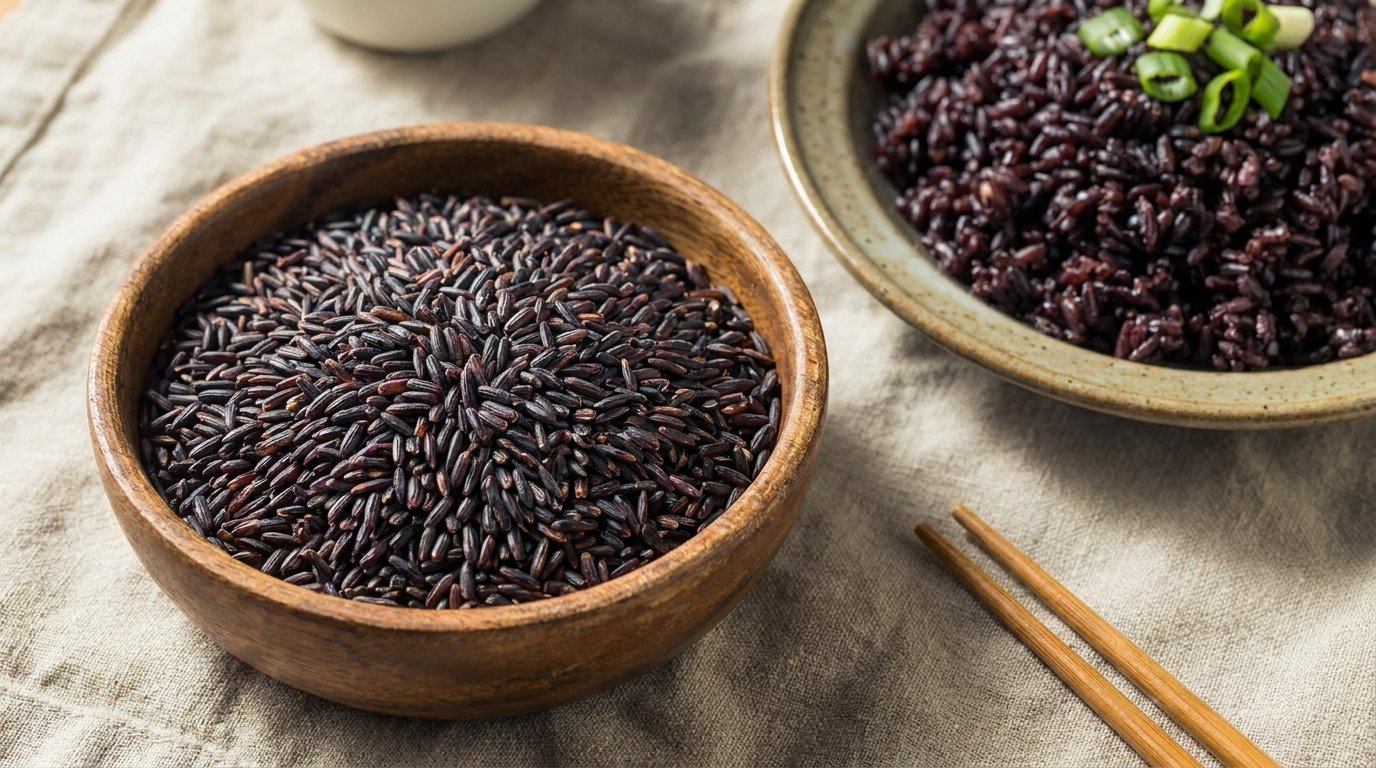
Type "black rice" into a wholesale directory and you'll get pages of listings — some organic, some not, some labelled organic without much behind the claim. This guide is written for buyers who need that difference to hold up past the point of sale: retailers building a clean-label range, importers filing customs paperwork, and private-label brands that can't afford a certificate that doesn't check out. What follows is what to actually look for when sourcing organic black rice wholesale, using Manipur's GI-tagged Chak-Hao Amubi as the reference point throughout.
What "Organic Black Rice Wholesale" Actually Means
The phrase carries two separate promises, and a buyer needs to check both. "Organic" is a certified farming claim — it means the grain was grown, handled and stored under a recognised organic standard, with paperwork behind it, not just grown "naturally" by a farmer who happened not to use chemicals that season. "Wholesale" is a trade term — it means the grain is sold in bulk, by weight, to a business that will resell, repack or use it, rather than a single retail-sized bag. Put together, organic black rice wholesale should mean certified organic grain, sold and documented at trade volume, not a retail product bought in a larger quantity and re-billed as bulk.
It also helps to know that "black rice" isn't one grain. Depending on the supplier, a wholesale quote for black rice could be Chinese forbidden rice, Thai riceberry, Indonesian ketan hitam, or Chak-Hao Amubi — the aromatic, glutinous black rice grown in Manipur's Imphal valley, and the only black rice in India carrying a Geographical Indication (GI) tag. They cook differently, store differently, and carry very different organic certification histories, so it's worth confirming exactly which grain sits behind an "organic black rice" quote before comparing suppliers on anything else.
Why Wholesale Buyers Are Choosing Organic Black Rice
Demand for organic black rice wholesale has grown for reasons that have less to do with the grain being trendy and more to do with where it ends up selling. Health-food retailers, private-label grocery brands, and hotel, restaurant and catering (HoReCa) buyers are all under pressure to stock pigmented, minimally processed whole grains, and black rice sits at the intersection of two things a modern shelf needs — an antioxidant story consumers already recognise from foods like blueberries, and an "organic" label that reduces the buyer's own compliance risk when reselling under that claim.
There's a practical side too. Buying organic at wholesale volume means the certification travels with the lot rather than something a retailer has to establish on their own, and it narrows the pesticide-residue exposure that import markets with strict maximum residue limits are increasingly checking for at the border. For a distributor moving container loads, that's not a marketing detail — it's the difference between a shipment that clears on schedule and one that gets held up.
Organic Certification: What to Verify Before You Order
Not every bag that says "organic" on the front has a certificate behind it, and at wholesale volume that gap becomes the buyer's problem, not the seller's. Before confirming an order, it's worth asking a supplier for specifics rather than taking the label at its word.
- Certifying body & standard. Ask which organic standard the certificate is issued under — in India this is typically the National Programme for Organic Production (NPOP), also referred to as Jaivik Bharat — and whether it's recognised under any equivalence arrangement for the market you're importing into.
- Certificate number & validity. A genuine certificate has a reference number and clear validity dates; ask for both rather than accepting a generic organic logo printed on packaging.
- Lot-level scope. Certification is often granted at the farm or farmer-group level, but the paperwork a buyer actually needs should tie to the specific harvest lot being quoted, not just confirm that organic farming happens somewhere in the supply chain.
- Independent lab testing. A supplier confident in their organic claim will usually share a recent pesticide-residue lab report alongside the certificate, not just the certificate on its own.
Where Wholesale-Grade Organic Black Rice Comes From
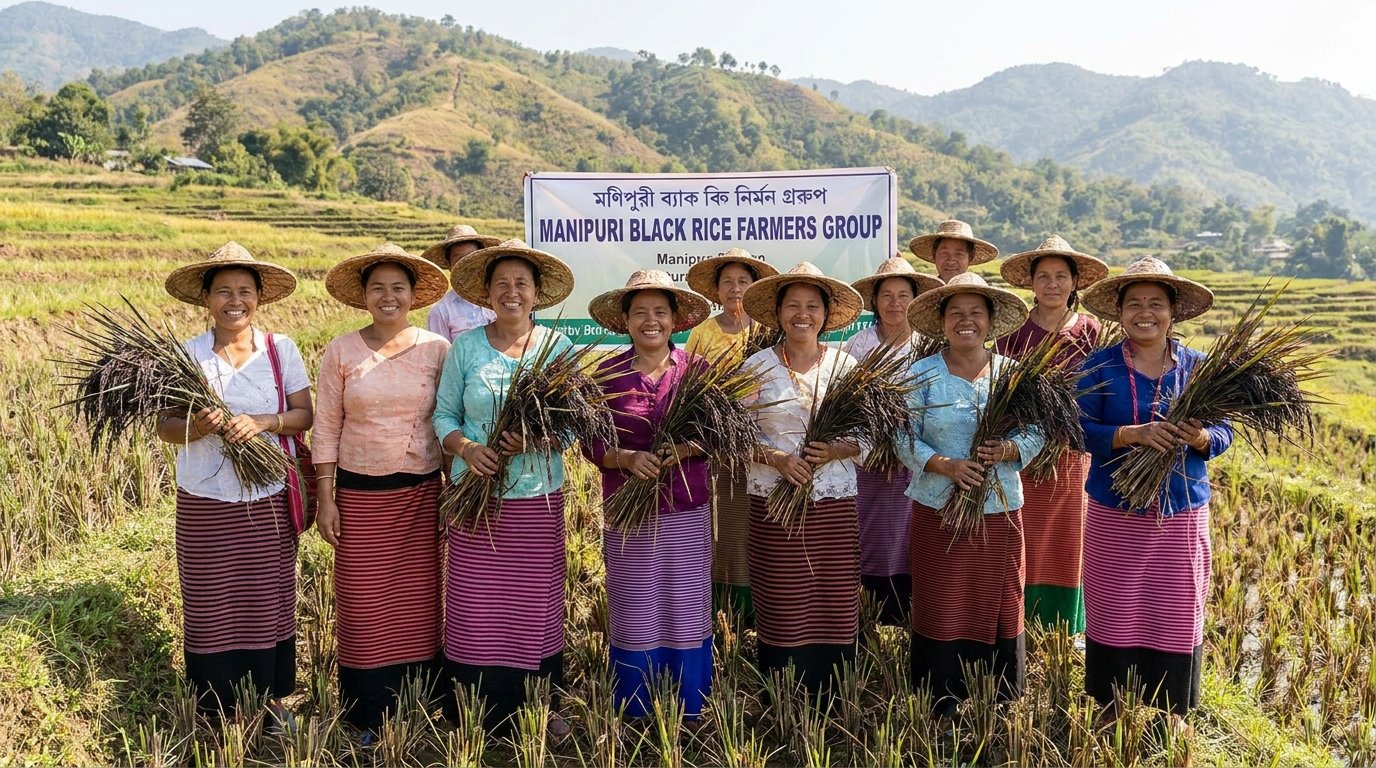
Most organic black rice sold wholesale globally traces back to a small number of origins, and each has its own growing conditions, grain character and certification history. Manipur's Imphal valley — ringed by hills and fed by monsoon rain — has grown Chak-Hao Amubi for generations, largely on smallholder farms that have relied on traditional, low-input cultivation rather than heavy synthetic inputs, which is part of why organic certification has been a relatively natural fit for the crop rather than a retrofit.
Since 2020, Chak-Hao has also carried a Geographical Indication tag, legally tying the name to rice actually grown within Manipur. For a wholesale buyer, that combination — GI-tagged origin plus organic certification — is unusually strong, because it answers both questions a due-diligence check normally has to chase down separately: where the grain came from, and how it was grown.
Grain Quality Parameters Every Wholesale Buyer Should Check
Organic certification tells a buyer how the rice was grown. It doesn't tell them anything about the grain itself — and at wholesale volume, grain quality is what determines whether a lot mills cleanly, cooks consistently, and doesn't come back as a complaint from a retail customer. A proper spec sheet should cover, at minimum:
- Moisture content. Rice stored above roughly 14% moisture is prone to mould and pest damage in transit; a wholesale spec should state a clear moisture ceiling, not just "dry."
- Broken grain percentage. Some breakage is normal in any milling process, but a spec sheet should cap it — buyers selling whole-grain black rice at retail typically want this kept low.
- Foreign matter & admixture. Stones, husk and grains of other rice varieties should be quantified as a maximum percentage, not left as "minimal."
- Grain colour & uniformity. Genuine Chak-Hao Amubi should be a deep, even purple-black rather than patchy brown-black — over-polished or blended lots often show inconsistent colour.
- Harvest & milling date. Freshness affects both aroma and cooking behaviour, so a buyer should know how long a lot has sat in storage before it ships.
A Typical Wholesale Spec Sheet
What buyers commonly request before confirming an organic black rice wholesale order.
Grain Purity
Minimum purity typically specified for wholesale-grade lotsMoisture Ceiling
Above this, rice is prone to mould and pest damage in storageBroken Grain Ceiling
Typical cap for whole-grain black rice sold at retail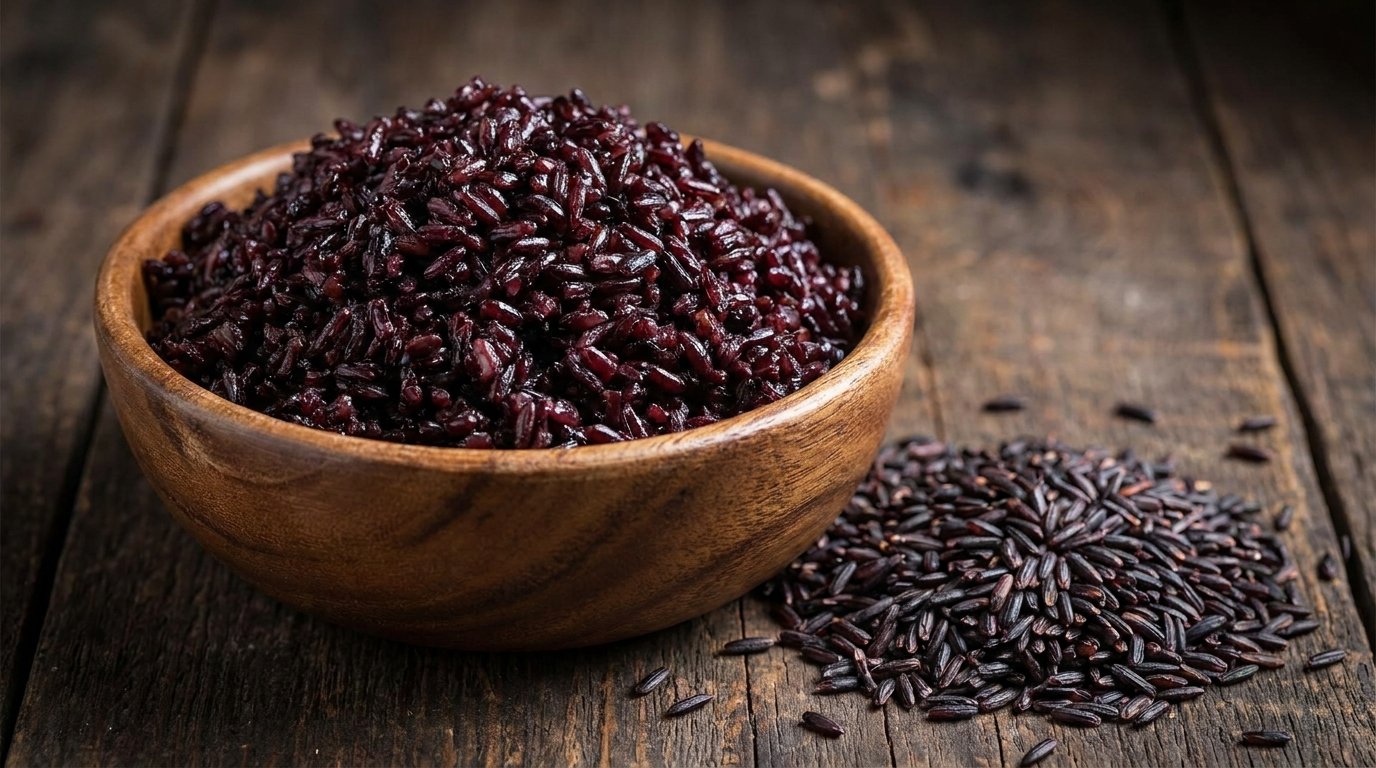
Nutrition Buyers Can Market With Confidence
For a retailer or private-label brand, the nutrition profile behind organic black rice wholesale isn't just background information — it's the claim that ends up on the pack. Because Chak-Hao is milled lightly enough to keep most of its bran and germ intact, it holds onto nutrients that disappear once rice is polished white, which is the whole basis of the "ancient grain" and "antioxidant-rich" positioning most black rice brands lean on.
The bran is where it happens. It's where the anthocyanins — the antioxidant pigment family also found in blueberries and purple cabbage — are concentrated, along with the fibre, protein and iron that polished white rice loses in processing. None of that requires exaggeration to be a genuine point of difference on a shelf.
Organic Black Rice vs. White Rice
Approximate, typical ranges — useful context for product listings, not lab-grade figures.
Packaging, Private Labelling & Bulk Formats
Wholesale packaging needs to solve two different problems depending on the buyer. A distributor moving volume typically wants formats that are efficient to freight and store — 25 kg and 50 kg woven or jute bags for trade quantities, scaling up to 500 kg–1 MT jumbo bags for industrial or milling buyers. A retail brand or private-label buyer usually wants the grain arriving in retail-ready pouches instead, either under the supplier's own packaging or custom-printed with the buyer's branding.
Private labelling at the wholesale stage means the buyer controls the front-of-pack story — their own brand name, their own claims, their own design — while sourcing the actual grain, certification and traceability from the supplier behind the scenes. It's worth asking early whether a supplier supports this, since not every bulk grain source is set up to pack to a buyer's specification rather than their own.
Minimum Order Quantities & Supply Capacity
Minimum order quantities for organic black rice wholesale usually work in two tiers. Trial orders — meant for testing grain quality, cooking behaviour and packaging before committing further — tend to start relatively small, often around 100 kg. Regular wholesale and export orders are a different scale entirely, typically quoted as full or partial container loads, which for black rice generally falls somewhere in the 1–24 metric tonne range depending on the buyer's shipping arrangement.
Because Chak-Hao is a monsoon-season crop, harvested once the rains ease off later in the year, supply capacity isn't perfectly flat across the calendar. Buyers planning large forward orders generally get better lead times by booking around the harvest window rather than requesting volume off-season, so it's worth checking current stock position directly with a supplier's trade desk rather than assuming year-round availability.
Ordering At a Glance
Typical order tiers and packaging range for wholesale organic black rice.
Placing a first trial order or scoping a container load? Our trade desk can confirm current stock, lead time and packaging options.
Export Documentation & Shipping Logistics
The paperwork behind an organic black rice wholesale shipment matters as much as the grain itself, particularly for buyers importing into markets with strict organic-labelling or food-safety enforcement. A complete document set for an export order should typically include:
- Organic certificate matching the specific lot, not just the farm or season in general.
- Certificate of Origin, referencing the GI status where the grain is Manipur-grown Chak-Hao.
- Phytosanitary certificate, confirming the shipment meets the importing country's plant-health requirements.
- Certificate of Analysis (COA), covering moisture, purity and any residue testing carried out on the lot.
- Commercial invoice & packing list, itemised by bag count, weight and lot number.
- Fumigation certificate, where required by the destination port or country.
It's reasonable to ask for this full set upfront, before a shipment leaves port, rather than piecing it together after the fact. A supplier who can produce all of it without delay is usually a good sign about how the rest of the order will go.
From Paddy to Port
The stages a wholesale lot of organic Chak-Hao moves through before it ships.
Organic-certified paddy fields
Harvest & sun-drying
Hulling, cleaning & grading
Lab testing: purity, moisture, residue
Bulk or private-label packaging
Export documentation
Container loading & shipment
Organic Black Rice Wholesale vs. Regular Black Rice Wholesale
Not every wholesale black rice quote is built the same way, and the difference isn't always obvious from a spec sheet alone.
Conventional / Non-Organic
Grown without organic certification requirements, often at lower cost and higher yield, but without residue testing or certified traceability behind the label.
Unverified "Organic" Claims
Marketed as organic without a certificate a buyer can actually check — no certificate number, no defined standard, no lot-level scope. The riskiest category to build a retail claim on.
Certified Organic + GI-Tagged Chak-Hao
Certified under a recognised organic standard, with GI documentation tying the grain to Manipur's Imphal valley and lot-level traceability from paddy to pack — the combination that holds up under both a retail audit and a customs check.
What to Look for in an Organic Black Rice Wholesale Supplier
Most of the risk in sourcing organic black rice wholesale sits with the supplier relationship, not the grain itself. A short checklist before committing to a first order:
- 1Ask for the certificate before the quote. A supplier who sends pricing before paperwork is usually not set up to produce the paperwork quickly later either.
- 2Request a sample lot. Grain colour, aroma and cooking behaviour vary more between suppliers than most buyers expect — a small trial order settles this before a container does.
- 3Confirm packaging and private-label capability upfront. It's a harder conversation to have once a purchase order is already signed.
- 4Get the full export document list in writing. Organic certificate, GI reference, phytosanitary certificate, COA, packing list — ask which are provided as standard.
- 5Check lead time against the harvest calendar. A supplier who explains their own seasonality honestly is generally more reliable than one claiming year-round availability without qualification.
Frequently Asked Questions
The Bottom Line
Organic black rice wholesale isn't a commodity you can shop on price alone — it's a certificate, a grain spec, and a paper trail that all need to hold up long after the container leaves the dock. Buyers who check the certification scope, confirm grain quality parameters, and get export documentation in writing upfront tend to avoid the problems that show up later, at customs or on a retail shelf. For the fuller story behind the grain itself — its GI tag, its history and how it's traditionally cooked — see our guide to Manipur black rice, or get in touch with our trade desk to discuss a wholesale or export order.