Search "black rice supplier" and most of what comes back is marketplaces and trading portals reselling whatever grain happens to be available that month. Manipur's Chak-Hao doesn't work that way — it's a single, GI-protected rice grown in one valley, and sourcing it well takes a supplier who can actually stand behind origin, quality and paperwork. This guide is written for the buyers who need exactly that: what to expect from us as a premium black rice supplier, wholesale black rice exporter and long-term trade partner, from your first sample to your fifth reorder.
Why Global Buyers Choose Us as a Premium Black Rice Supplier
Most black rice sold internationally has already changed hands two or three times before it reaches an importer, which makes origin and quality hard to pin down. We work the other way around: Chak-Hao is sourced directly from smallholder farmer partners in Manipur's Imphal valley, milled and packed to a fixed specification, and shipped with the documentation to prove where it came from. That's the difference buyers are usually trying to find when they type "premium" in front of a commodity search.
Three things tend to matter most to the wholesale buyers, distributors and private-label brands we work with:
Verified Single Origin
Every lot traces back to named farmer groups in Manipur's Imphal valley, backed by Chak-Hao's Geographical Indication status — not a blend of black rice sourced wherever it was cheapest that quarter.
Lab-Tested, Documented Quality
Batches are tested and specified before they ship, so what's on the certificate of analysis matches what arrives at your port — not a surprise you discover after customs clearance.
Built for Repeat Orders
Our supply chain is set up for wholesale cadence — trial lot, first container, then a standing relationship — rather than a one-off spot sale that's hard to reorder against.
What "Premium" Actually Means When You're Sourcing in Bulk
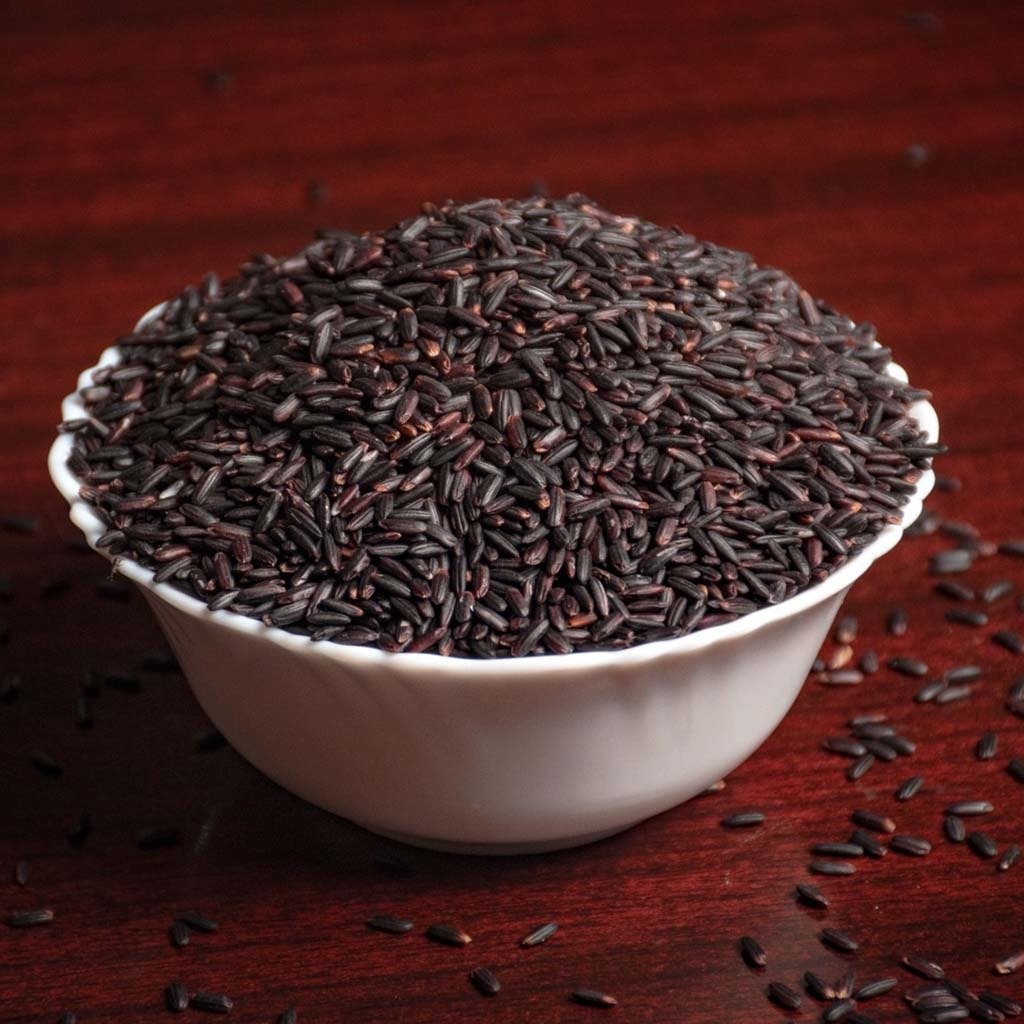
At retail scale, "premium" is mostly a shelf story. At wholesale scale, it has to survive a certificate of analysis. For black rice specifically, that comes down to how tightly moisture, broken grain, foreign matter and milled purity are controlled — because Chak-Hao's thick, pigmented bran layer is easy to over-mill or under-dry if a supplier isn't paying attention.
Typical Export-Grade Specification
This is the standard specification we contract against for wholesale and export orders. A certificate of analysis for the specific batch is provided with every shipment, so the numbers you agree to are the numbers you receive.
None of that happens by accident. It's the reason Chak-Hao is milled lightly rather than polished hard — enough to remove the husk cleanly without stripping away the anthocyanin-rich bran that gives the rice its colour, aroma and much of its nutritional value in the first place.
Our Wholesale & Export Supply Capabilities
Buyers usually ask two questions in the same breath: can you actually supply the volume, and can you keep supplying it next season. Here's the honest shape of our capacity.
Minimum Order
Trial lots from 100 kg, scaling up to full container loads for repeat wholesale buyers.
Container Sizes
20-foot and 40-foot FCL, palletised or block-stuffed depending on your destination port.
Typical Lead Time
15–20 days ex-factory once an order and specification are confirmed in writing.
Packaging Range
500 g retail pouches up to 1 MT jumbo bags, including private label formats.
Operational Readiness Across Our Supply Chain
Milling & Sorting
Export Packing Lines
Dry Warehousing
Private Label Set-Up
A relative view of how quickly each stage of our supply chain can flex for a new order — not a precise utilisation figure, but a fair guide to where we can move fastest.
Certifications & Food-Safety Compliance
A bag of black rice doesn't tell an importer much on its own. What convinces a compliance team is the paperwork behind it, so this is the documentation stack we work with:
- GI-tagged origin. Chak-Hao has held a Geographical Indication tag since 2020, granted after the Consortium of Producers of Chak-Hao filed with support from Manipur's Department of Agriculture and NERAMAC. It legally ties the name to rice grown in Manipur.
- Organic status. Chak-Hao is traditionally grown with little reliance on synthetic fertiliser or pesticide, and we can share recognised organic certification on request rather than asking buyers to take that on trust.
- Batch-wise lab testing. Consignments are tested for pesticide residue, heavy metals and moisture before packing, with results attached to the shipment as a certificate of analysis.
- Export documentation. Legally exporting rice from India involves holding an Import-Export Code from the Directorate General of Foreign Trade, registering with APEDA, and securing a phytosanitary certificate from the Directorate of Plant Protection, Quarantine & Storage — all of which travel with your consignment.
- Certificate of origin. Issued per shipment to support customs clearance and to back up the GI claim on the label at the other end.
Export Markets We Serve
Specialty black rice moves through different channels than mainstream commodity rice — think gourmet grocers, health-food distributors and hospitality buyers rather than bulk staple-food import. Here's roughly how our current wholesale order volume splits by region.
Regional Mix of Wholesale Orders
An approximate mix of current wholesale order volume by region — it shifts a little every season as new markets come online, so treat this as a general picture rather than a fixed quota.
Buying premium black rice in bulk for a market not listed above? We can usually still ship there.
Packaging, Private Label & OEM Options
Packaging does two jobs for pigmented rice like Chak-Hao: it protects the anthocyanins in the bran from light and moisture, and it carries whatever story you want to tell your own customers. We support both bulk shipping formats and fully branded private label runs.
Stand-Up Pouch
500 g–1 kg zip pouches with a light-blocking finish, printable with your own artwork for private label retail sale.
Multiwall / PP Bag
5–50 kg woven bags with a food-grade liner, the standard format for food-service and distributor orders.
Export Carton
Carton-packed retail units palletised for FCL shipment, suited to supermarket and specialty-store distribution.
Jumbo (FIBC) Bag
1 MT bulk bags for full container loads, typically used by processors and large-volume distributors.
For private label and OEM orders, our team can also advise on label compliance — including how the GI mark may and may not be used on packaging that carries your own brand name.
How Our Wholesale Ordering Process Works
There's no separate "wholesale department" you get routed to — the same trade desk handles your enquiry from the first message through to the shipment leaving port.
- 1Share your requirement. Tell us the grade, quantity, destination port and packaging format you need — a rough estimate is fine to start with.
- 2Review a lab-tested sample. We send a sample set matched to your intended order so you can check aroma, grain size and cooking behaviour before committing.
- 3Confirm the agreement. We finalize a proforma invoice, the specification sheet and the export documents your order will need.
- 4Production, packing & quality control. Your order is milled, sorted and packed to spec, with batch-level checks at each stage.
- 5Shipment & documentation. We handle container loading, customs paperwork and shipment tracking through to your destination port.
- 6After delivery. Our trade desk stays reachable after the shipment lands, including for repeat and seasonal orders.
Traceability From Paddy to Port
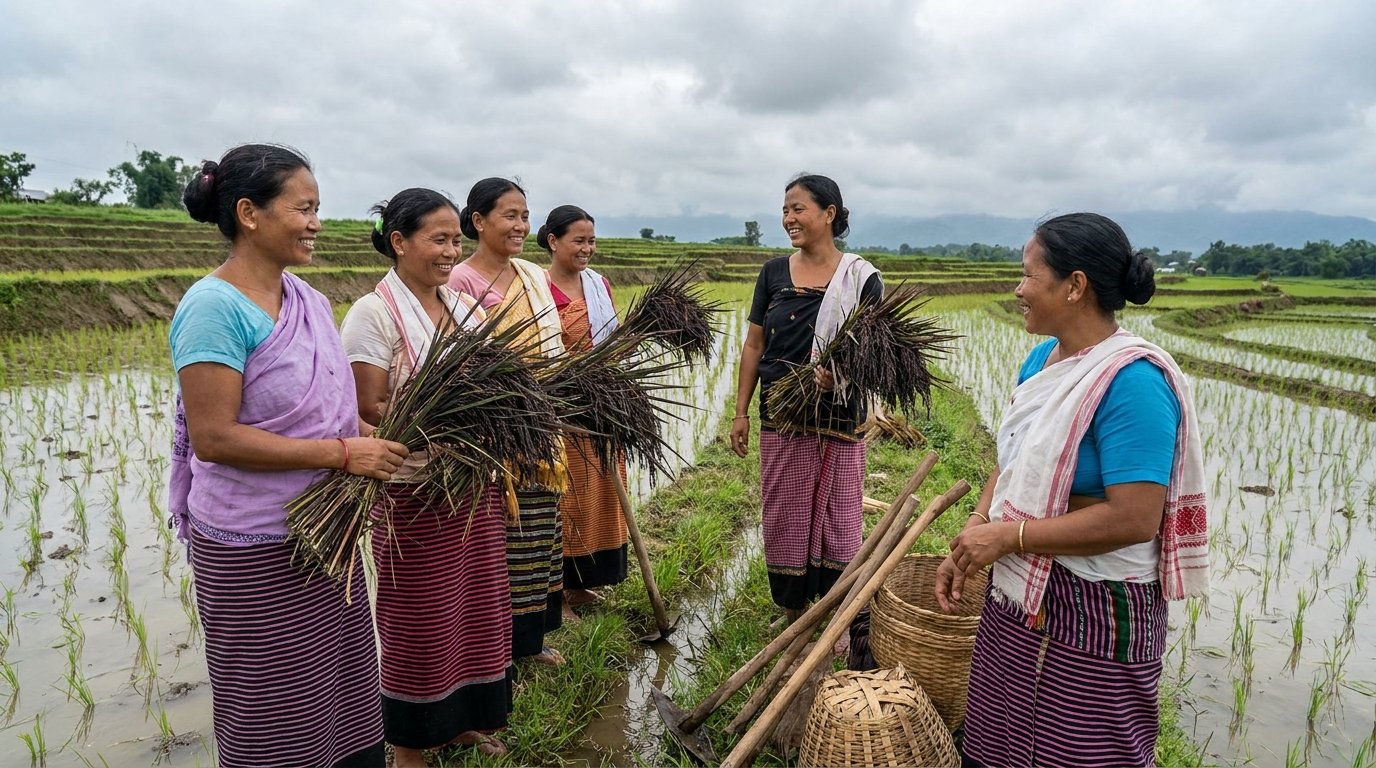
Chak-Hao is grown across the wetland valley around Imphal, mainly in the districts of Imphal East, Imphal West, Bishnupur and Thoubal, by smallholder farming households rather than large industrial operations. We work with named farmer groups in these districts rather than an anonymous grain pool, and every export lot carries a batch number tied back to the harvest it came from.
That matters for two reasons: it's what makes the GI-tag claim on your packaging defensible if a customs officer or a retail buyer's compliance team ever asks, and it means that if a batch ever needs to be traced back for any reason, we can actually do it — not just point at a general region on a map.
Sustainability & Farmer Partnerships
Chak-Hao has stayed a smallholder crop for a practical reason as much as a cultural one: the older landraces grow tall and yield less per hectare than commercial white rice, so it's never made sense to farm it at industrial scale. That's turned out to be an advantage for buyers who care about sourcing ethics — the crop has largely stayed low-input by tradition rather than by certification exercise.
We work directly with farmer households rather than through layers of aggregators, which keeps the chain of custody short and gives farmers a more direct stake in the export value their crop eventually reaches. For buyers running their own supply-chain audits, that's usually easier to document than a rice sourced through an open commodity market.
FAQs for Wholesale Buyers & Importers
The Bottom Line
Being a premium black rice supplier isn't a claim you can put on packaging and leave at that — it has to show up in the paperwork, the consistency of the grain, and how the relationship holds up after the first container. That's the standard we hold ourselves to as a wholesale black rice supplier and exporter of Manipur's GI-tagged Chak-Hao: verified origin, tested quality, and a trade desk that's still there for your third order, not just your first. If you're weighing us up as a supplier, it's worth reading our complete guide to Manipur black rice alongside this one, or heading straight to our product page to start a conversation.
Further reading
- APEDA, Government of India — Requirements for export of rice from India
- Wikipedia — Geographical Indications of Goods (Registration and Protection) Act, 1999
- MyGov Blogs — GI-tagged agricultural products of Manipur
- Legacy IAS Academy — GI tag awarded to Manipur black rice (Chak-Hao)